“The past is never dead. It’s not even past.”
William Faulkner
Documentaries and articles about the War of 1812 tend to refer to it as a “forgotten war.” That’s probably true in most of the United States, but there are pockets of the country where the story of that war is intertwined with a community’s identity. In New Orleans, Andrew Jackson’s (technically post-war) victory there against the British in 1815 is still regarded as a big deal. Baltimore is very proud of the legacy of Fort McHenry and “The Star-Spangled Banner.” And here in Oswego County, we continue to keep the memory of the area’s role in “Mr. Madison’s War” alive.
Lake Ontario, generally, was a major theater of the war and the site of numerous naval engagements and land battles along the shore. In 1814, the British landed in Oswego, defeated the American defenders, wrecked some buildings, captured some supplies, and then sailed off. It was a pretty minor battle in the broad scheme of things but remains a significant part of local lore. As such, there are a number of War of 1812 historical markers around the city and, of course, at Fort Ontario. Those signs are so familiar, I barely notice them.
The other day, I was driving on Route 104 in Scriba, east of Oswego. That’s a stretch of road where I rarely have occasion to travel. Driving along, I noticed a sign marking a roadside pull-off rest area as being a War of 1812 history site. My curiosity was piqued. I had never seen the sign before and wasn’t aware of any battle or skirmish that had occurred in that area. Naturally, I pulled off to investigate.
The rest area was a loop with a few picnic tables and some signs ringed with stonework. It was actually a nice little sanctuary.
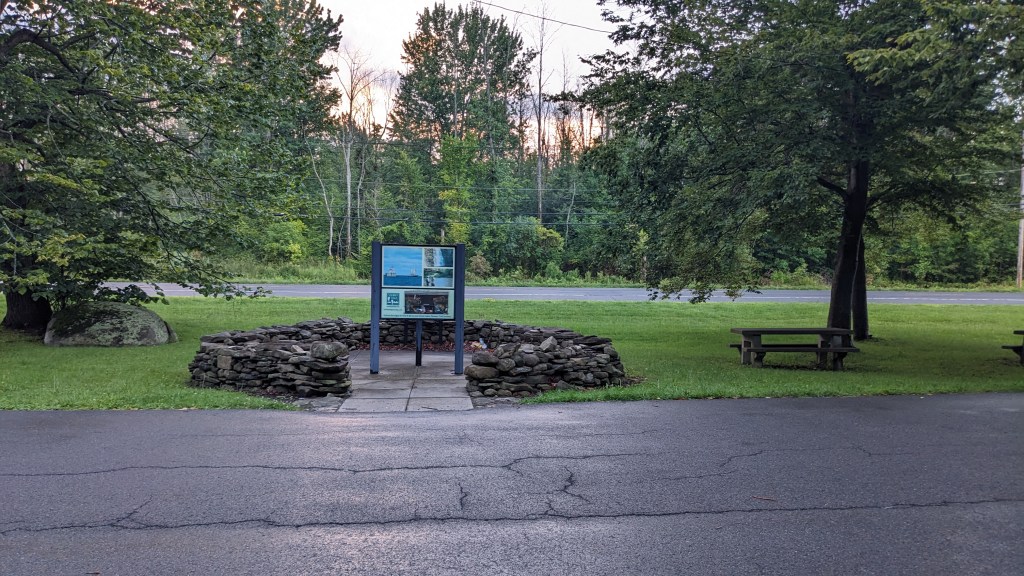
When I got up to the signs, I discovered the area was really just a tourism-focused stop along the Great Lakes Seaway Trail. The historical component was a general information sign about some of the notable engagements and commanders of the war. I was hoping to discover a new specific nugget of information about that particular location, but instead got sort of a Reader’s Digest summary of a broad theater of operations.
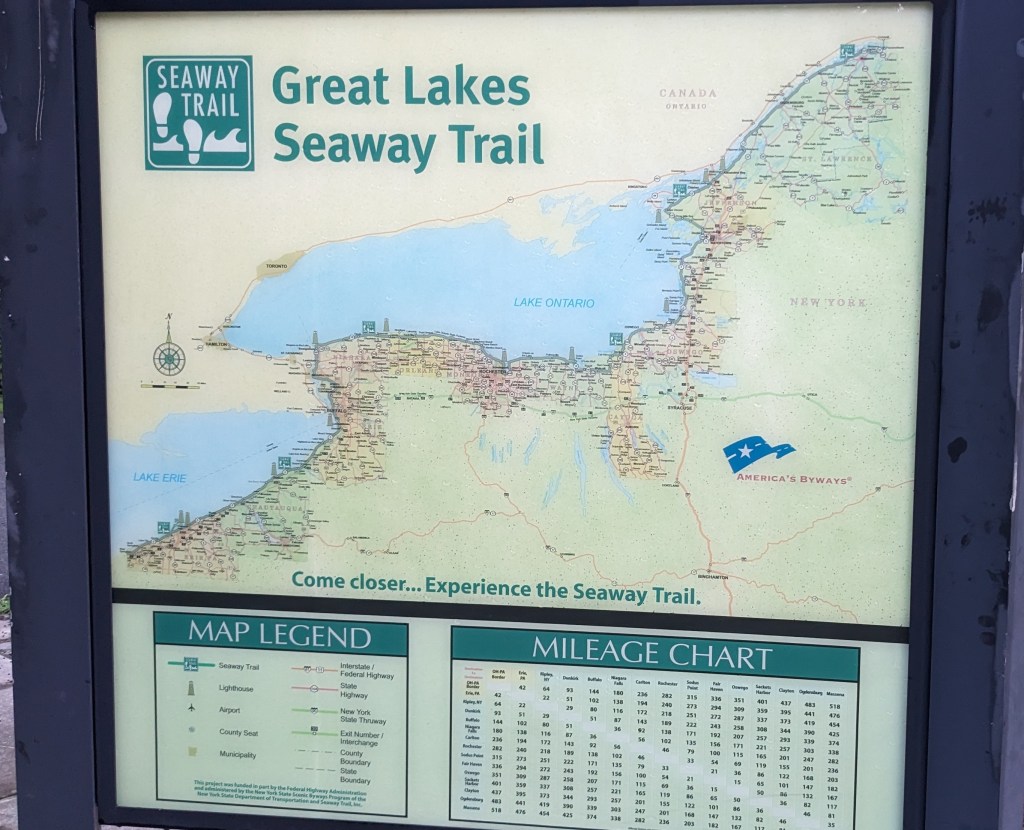


My slight disappointment aside, I’m glad this site exists. Most Americans don’t know or care much about the War of 1812, but around here, the memory still resonates. And if this little corner of the world doesn’t celebrate the maritime derring-do of Lt. Melancthon Woolsey, who will?


 a.k.a. V.J.
Leave a comment