“This is our big mistake: to think we look forward to death. Most of death is already gone. Whatever time has passed is owned by death.”
– Seneca
We all waste time. We all procrastinate. We all kick the can down the road on doing worthwhile things because we are so preoccupied with the day-to-day grind.
But would you be less inclined to dither if you were keenly aware of how little time you actually had left on the planet? The producers of Momento Mori calendars believe that you would, and they have just the offering to remind you of your dwindling lifespan: a system for ticking off each week of your life that has passed, leaving you a visual representation of how far along you are on your journey toward death.
That may sound like a work of dark humor or morbid fatalism, but it is neither. Memento Mori (Latin for “Remember you must die,”) is a philosophical concept with roots in ancient Stoicism, designed to make people appreciate the preciousness of time. The idea is not to wallow in fear over death, but, on the contrary, to develop a fear of not living up to our potential during the limited time we have.

Truth be told, I didn’t really need a calendar, or the writings of Marcus Aurelius to make me acutely aware of mortality. I am at the point in life where relatives, friends, peers, acquaintances, former classmates, and various public figures who are my age or younger pass away with depressing frequency. Both of my parents are gone, as is my brother. If I ever harbored any delusions of immortality, a steady stream of loss has long since disabused me of them.
“You could leave life right now. Let that determine what you do and say and think.”
– Marcus Aurelius
Has my personal awareness of mortality changed my approach to life? It has. For me, the turning point was back in 2015 when I was diagnosed with Type 2 diabetes. That’s a manageable condition, but it was a wakeup call that I had a serious disease that could and probably already has made my life shorter. At that point, I knew very little of Stoicism and nothing of Latin death slogans, but I did start living my life with a newfound urgency and gratitude. When I started reading Stoic philosophy a couple years ago, I was already pretty far along the road of being intentional with my time.
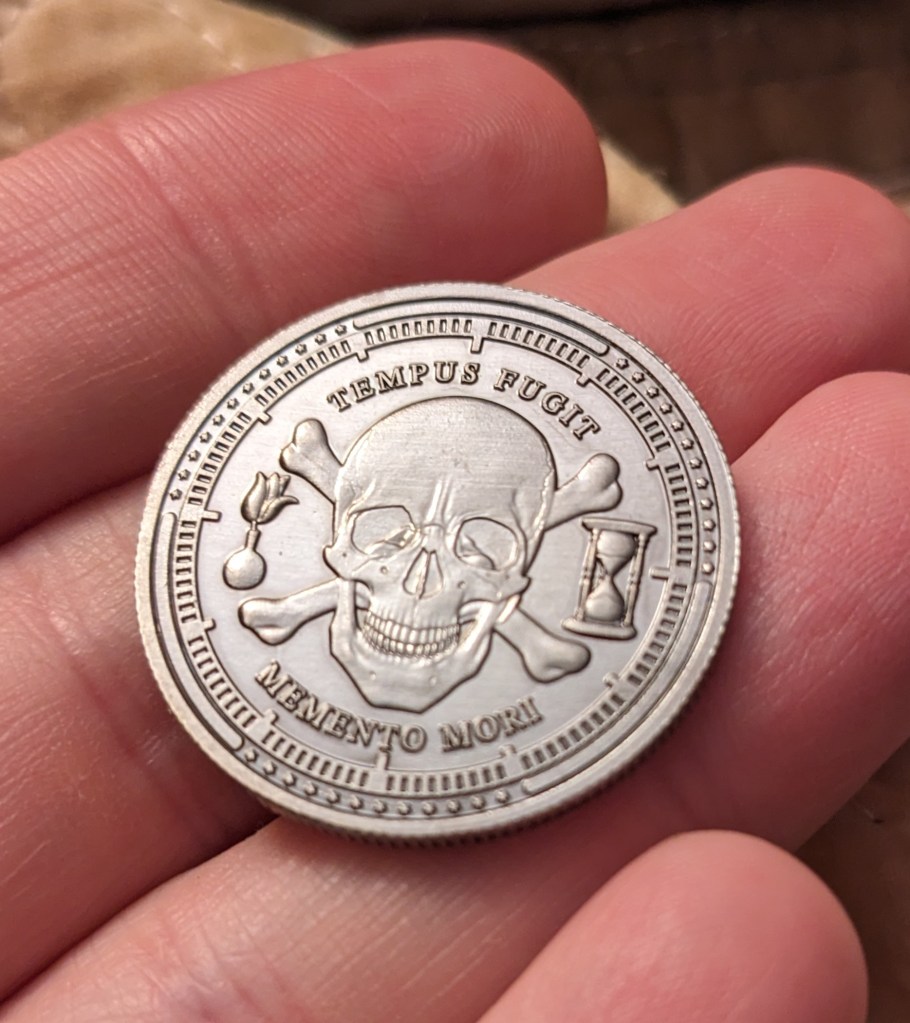
Do I believe that maintaining a Momento Mori calendar or carrying a coin like mine around would save people from a life of endlessly scrolling through stale social media posts, frittering away hours every week playing Candy Crush, or failing to get started on the Great American Novel? Probably not. In fact, I believe that for many people, exposure to the Memento Mori concept would do more harm than good.
Humans are very good at ignoring reminders of death. There is a psychological concept called Terror Management Theory that posits denial of death is an evolutionary defense mechanism. If we thought too much about dying, we would be too afraid to do anything, so we are wired to ignore or deflect reminders of our eventual demise, even valid ones.
At the same time, I also understand that inaction is usually rooted in fear. We don’t normally put actions off out of simple laziness, but because we have anxiety surrounding them. Procrastination is a manifestation of cowardice. That being said, Memento Mori is a bit of a shock tactic. The idea is to jolt you into doing more by shattering the illusion that you have plenty of time to do it all later. That sounds good in theory, but in practice, it’s pretty hard to scare somebody out of being scared.
In short, Memento Mori is not for everyone. Nor is Stoicism in general, for that matter. It can be a demanding philosophy to put into daily practice. Stoicism never lets you off the hook. It chides. It challenges. It nudges you in the ribs and reminds you that you have to die. But, if taken in the right spirit, that last thing can turn your whole life around.
“How long are you going to wait before you demand the best for yourself?”
– Epictetus


 a.k.a. V.J.
Leave a comment