Yesterday, I was doing some lecture prep for the course I am teaching in Integrated Marketing Communications. This week’s module delves into communication theory and how traditional communication models can be used as a framework for understanding advertising, public relations, direct marketing, etc. The textbook features a standard model of the communication process very much like the one below.

Looking at the model, I had a flashback to 1989 when I was a fresh-faced undergraduate taking a communication theory course, looking at the same basic image, on the same campus where I’ll be lecturing 35 years later. Cue the Lion King “Circle of Life” song.
The older I get, the more I experience moments like that — vivid echos from the past triggered by recurring patterns of behavior, circumstance, or setting. I suppose it happens to everyone, but living in the same house I grew up in and working on the same college campus where I went to school probably makes me more prone to it than most. Flashbacks of that nature happen so often that I probably wouldn’t have given it much thought had I not been, at the same time, reading a book dealing with the concept of eternal recurrence.
I’m currently trudging through Friedrich Nietzsche’s Thus Spoke Zarathustra. I say “trudge,” because Zarathustra is a challenging read to say the least. Part of that is because the translation I’m working with is written in a deliberately archaic English evocative of that in the King James Bible. Mostly, though, the content is a loopy mix of philosophy, fiction, and poetry written by an author who was experiencing some mental-health challenges. Reading this book, I find myself wading through Nietzsche’s purple rants, barely even processing the words, but every so often stopping on a nugget so profound and ringing so true that it practically takes my breath away. Beneath everything else going on in the book, Thus Spoke Zarathustra is about eternal recurrence — the idea that the universe is stuck in an endless loop, and our lives will repeat in exactly the same sequence forever. Teutonic Groundhog Day.
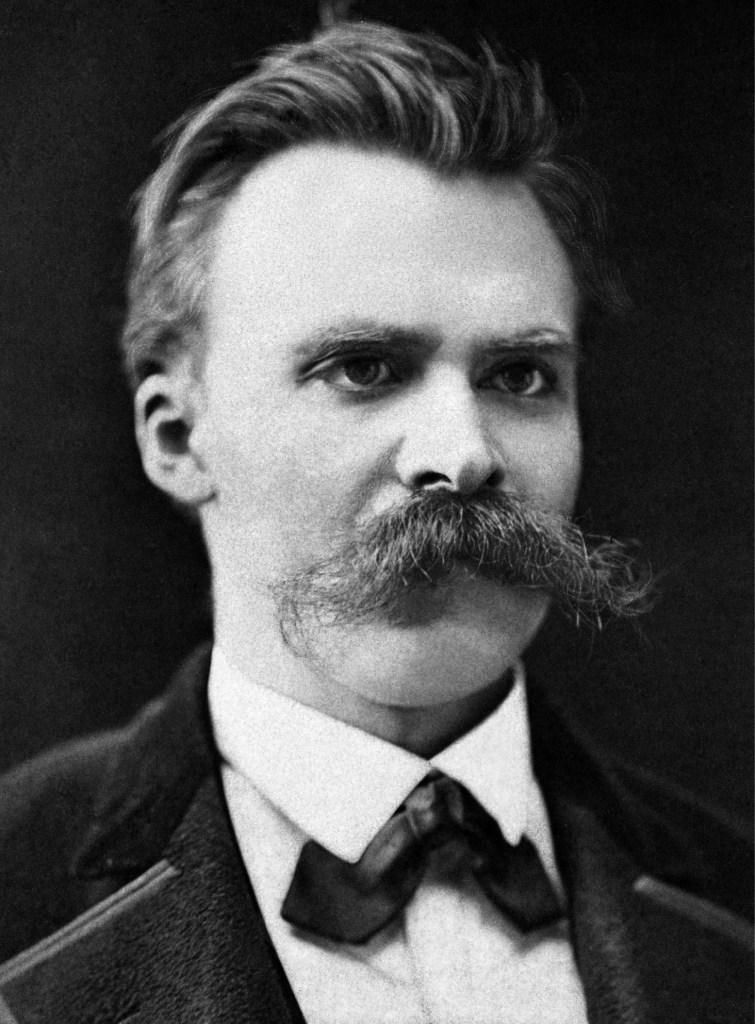
The concept of eternal recurrence is antithetical to a lot of our American cultural assumptions and aspirations. We want to believe in progress, that there’s something new and different and better waiting for us over the horizon. (If you doubt my basis for that assumption, I’ll remind you that I teach advertising.) To the extent that we think about repeating patterns in life, we talk about them in negative terms: “stuck on a treadmill,” “vicious cycles,” “doomed to repeat our mistakes,” etc.
But would repeating life on an endless loop really be so bad if we were living well in the first place? I mostly enjoyed my experiences as college student, and I mostly enjoy my experiences as a college instructor. The fact that the latter sometimes echos the former is pleasant rather than a cause for dread. So could it be with everything else. Even if eternal recurrence is nothing more than a weird philosophical thought experiment, it behooves us all to live lives that we wouldn’t mind reliving again and again. I think that’s ultimately what Nietzsche was getting at in Thus Spoke Zarathustra. But then again, Nietzsche died insane and infected with syphilis, so your mileage may vary.


 a.k.a. V.J.
Leave a comment