About a month ago, I started reading a novel by Charles Bukowski called Pulp. I selected it on a whim. I was in the mood for something short and I had seen enough about Bukowski’s persona as the “poet laureate of Los Angeles low-life” that I was intrigued.
Pulp is a quirky little book. It’s mostly a send-up of hard-boiled detective fiction, with a sci-fi subplot thrown in, and a trippy supernatural ending. I enjoyed Bukowski’s minimalist writing style and his self-deprecating humor so much that I decided to take a deeper dive on his work.
I followed Pulp up with two of his largely autobiographical novels: Factotum and Post Office. The former was very good and the latter was outstanding. I may elaborate on my experience with Bukowski’s prose at some point, but that is for another post. In this post, I want to discuss the other reading tangent I followed after reading Pulp, which was reading some actual pulp fiction.

Wikipedia describes pulp fiction as:
Pulp magazines (also referred to as “the pulps”) were inexpensive fiction magazines that were published from 1896 until around 1955. The term “pulp” derives from the wood pulp paper on which the magazines were printed, due to their cheap nature….
The pulps gave rise to the term pulp fiction in reference to run-of-the-mill, low-quality literature. Successors of pulps include paperback books, such as hardboiled detective stories and erotic fiction.
I have been meaning to sample some pulp for a long time. Without having actually read much of it, I do have a deep appreciation of its cultural importance. A lot of our current popular entertainment and genre fiction can be traced directly back to pulp origins. I hold romanticized notions of the pulps as true Americana and as an artform for the common person. My mother used to read pulps when she was young, and she told me that my grandfather would often have a pulp western magazine stuffed in his pocket to read in stolen moments.
The back catalog of pulp fiction is vast, and it covers pretty much every genre a reader could want. The challenge wasn’t finding some pulp to read but deciding where to start and which authors and characters to sample. I decided to go with something of a greatest hits/sampler platter approach and read the following works:
- Red Shadows, Robert E. Howard. Howard is best known as the creator of Conan the Barbarian, but Red Shadows features Solomon Kane, a grim 16th Century Puritan witch-hunter/swashbuckler. The story starts in rural England and somehow winds up in Africa. Swordplay, revenge, supernatural goings-on, and dour Calvinist theology ensue.
- “Ride, You Tonto Raiders” and “War Party,” both short stories by Louis L’Amour published in a compendium called Big Country, Volume One. Last year I read a Zane Grey western and mostly enjoyed it. After sampling these two stories, I concluded that L’Amour was a much better writer than Grey. Now I understand why the western sections of bookstores and libraries are so dominated by L’Amour’s books. He was simply a really good storyteller, and in some ways, ahead of his time.
- The Black Master, Walter B. Gibson. This book was part of the extensive Shadow series. My mother and aunt used to talk about listening to The Shadow radio show when they were kids. I’m guessing the radio show must have featured a more sanitized version of the character, as the print version of The Shadow was dark, violent, remorseless, and cackled maniacally with little provocation — certainly not a traditional hero. Some have claimed that many aspects of Batman were pretty shamelessly ripped off from the Shadow. After reading this book, I can only say to that: yup.
- Fortress of Solitude, Kenneth Robeson — an installment of the long-running Doc Savage series. If the Shadow was the precursor to Batman, Doc Savage, a.k.a. “the Man of Bronze” sure seems to have lent a lot of inspiration to Superman (case in point: the title of this book). In addition to Superman, aspects of Savage can be seen in two other later cultural icons: Indiana Jones and James Bond. Basically, Doc is a guy who is stronger, smarter, better looking, more educated, has access to better gadgets, thinks more moves ahead, has more connections in the right places, and possesses more moral rectitude than anyone he goes up against. Somehow, despite all that, the character doesn’t come off as insufferable.
- A Princess of Mars, Edgar Rice Burroughs. This, the first book of the John Carter series, is the granddaddy of a lot of the science fiction adventures that came later. Flash Gordon, Star Wars, and many other franchises owe a debt to John Carter’s adventures on Mars. This particular book was entertaining, if a little odd. The main character is a (possibly) immortal Civil War veteran who involuntarily travels to Mars via astral projection, discovers that he has superhuman strength and agility on that planet, and gets embroiled in all manner of Martian political and military intrigues. I won’t give away the ending, but I’m guessing that readers back in 1912 took it about as well as Sopranos fans took that TV show’s series finale.
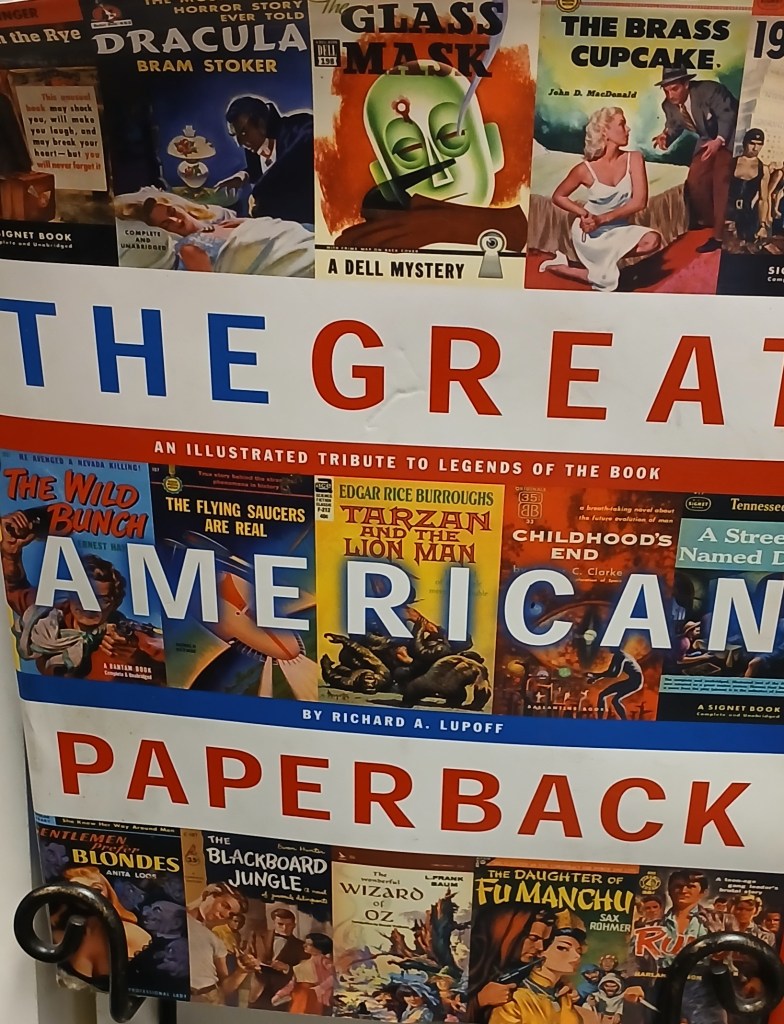
So, what was my takeaway from this foray into pulp? It was fun and entertaining, which is exactly what the pulp publishers were going for. Pulp was mass entertainment in the best sense of the term. Like Motown, Tin Pan Alley, or Hollywood in the days of the studio system, the pulps turned out a lot of good stuff without being precious about the artistic process. It was a high-volume business, and the publishers cared more about sales than critical accolades.
None of the pulp works I read would be counted among the best fiction I ever read, but all of it was more entertaining than most of the movies or TV shows I’ve come across in the past decade. I think today’s entertainment industry could learn a lot from those old pulps in terms of engaging audiences with simple, coherent stories that deal with timeless themes and never forget to have fun.



 a.k.a. V.J.
Leave a reply to Vance Marriner Cancel reply